
Slope in a Closely Jointed Rock Mass (FLAC2D)
This example reproduces example 1.4.6 from the FLAC/Slope 8.1 manual. The project file for this example may be viewed/run in FLAC2D.[1] The main data file used is shown at the end of this example.
Problem Statement
The effect of joint orientation on the stability of a rock slope is illustrated in this example. The rock mass contains a single closely spaced joint set. Three orientations of the jointing are investigated: joint angles of 10°, 45° and 135°, measured counterclockwise from the horizontal plane.
Model Generation
The model geometry is created using Sketch. After creating a new Sketch set, open the Slope Wizard and enter the following parameters:
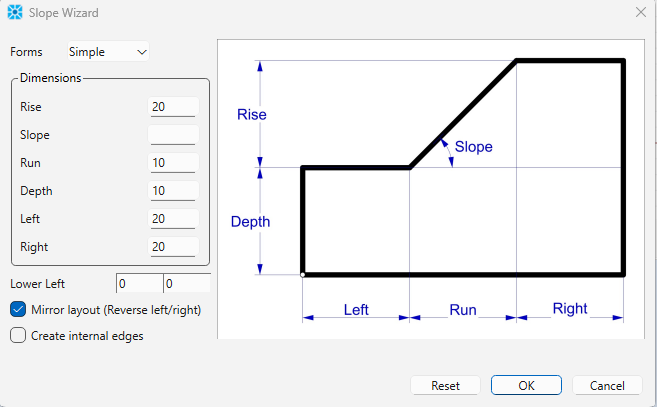
Select  from the mesh drop-down menu and set the zone size to 1. Now select
  . Finally, Click the button to Create Zones
  and save the project and the model state. Create a plot of zones to see the model (Figure 2). Optionally, you can also select the State Record tab above the console pane, right click, and select .
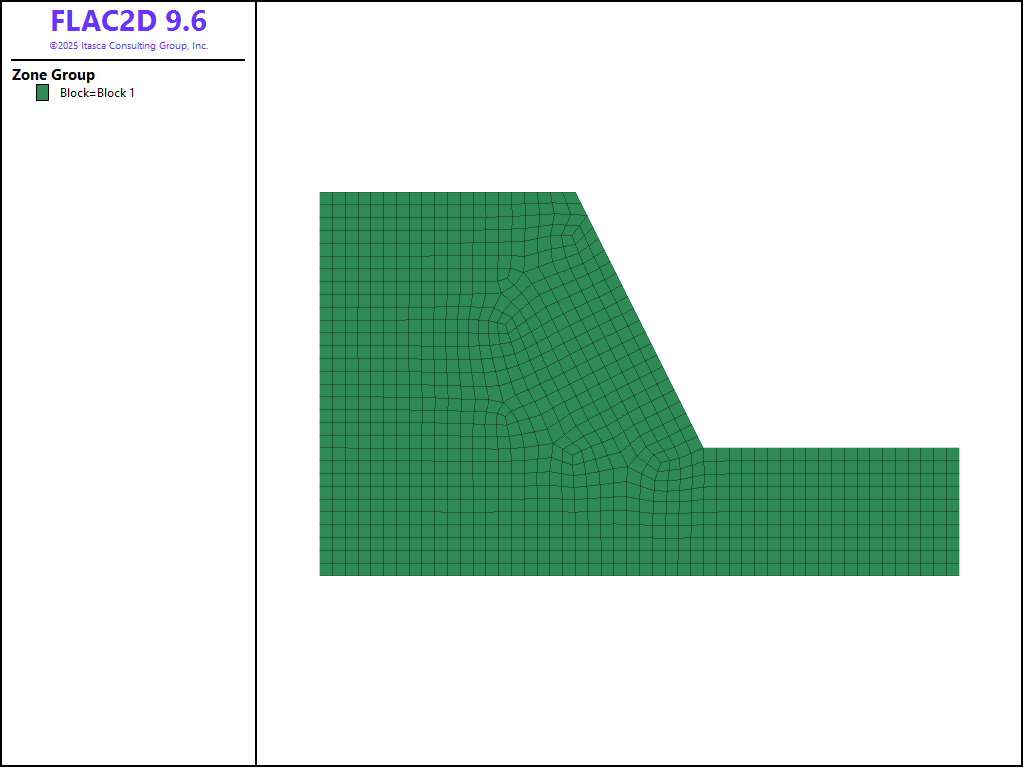
Figure 2: The zoned model
Properties and boundary conditions are specified with commands in data files (data files) The behavior of the jointed material is simulated with FLAC2D’s ubiquitous-joint model. The rock mass has the following intact material properties.
density 2500 kg/m3
cohesion (c) 0.1 MPa
friction angle (φ) 45°
tensile strength (\(σ_t\) ) 0.0
The joint properties are
cohesion (\(c_j\) ) 0.01 MPa
friction angle (\(φ_j\)) 40°
joint tensile strength (\(σ_{jt}\) ) 0.0
The stability condition for a 20 m high 1:2 (H:V) slope is evaluated for the three jointing orientations.
Results
For comparison, a simulation is first made neglecting the presence of the jointing (i.e., by using the Mohr-Coulomb material model and the intact rock properties). The calculated factor-of-safety for this case is 2.19, and the failure surface results are shown in Figure 3.
When the jointing is included with a joint orientation of 10°, the effect of the jointing is negligible. The factor of safety for this case is 2.16, and the failure surface results are very similar to the Mohr-Coulomb material case (compare Figure 4 to Figure 3).
As the joint orientation angle is increased, the effect of the jointing becomes more evident. For the case of the 45° joint orientation, the factor of safety is 1.75, and the failure surface is more aligned with the angle of the slope, indicating a toppling mode of failure. See Figure 5. The failure mode now includes both shear and tensile failure along the joints. At a joint orientation of 135°, slip along the jointing is the predominant mode of failure. This is evident from the failure plot in Figure 6. The factor of safety in this case is 1.09.
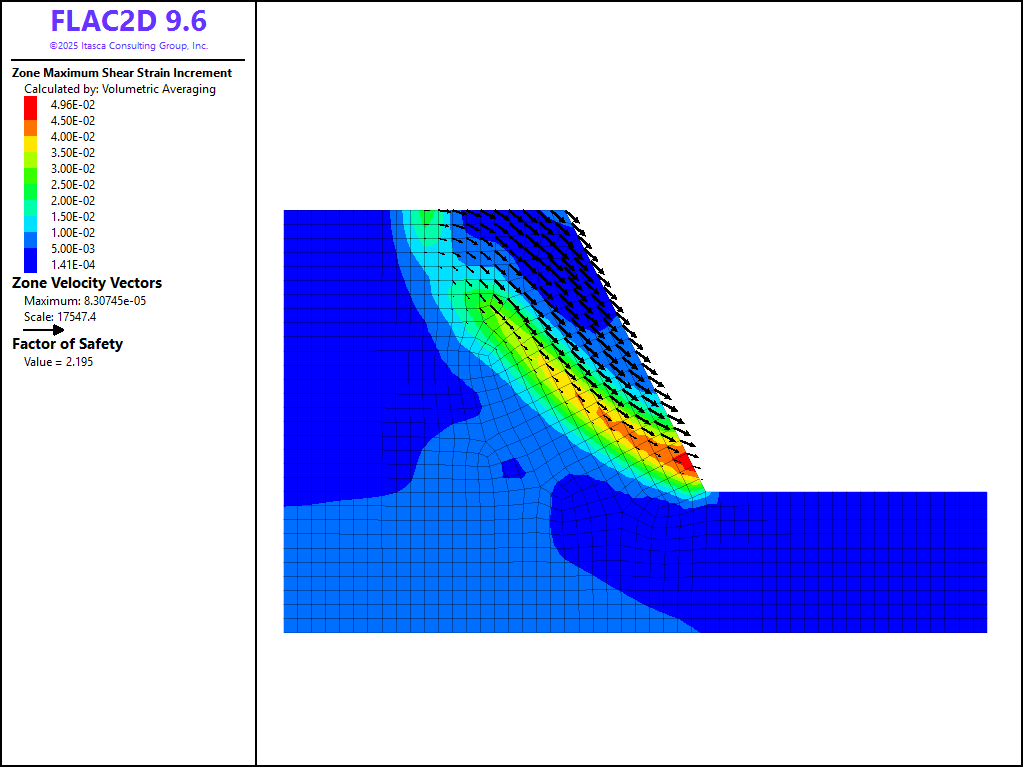
Figure 3: Factor-of-safety plot for rock slope neglecting the presence of jointing – velocity vectors and shear strain contours.
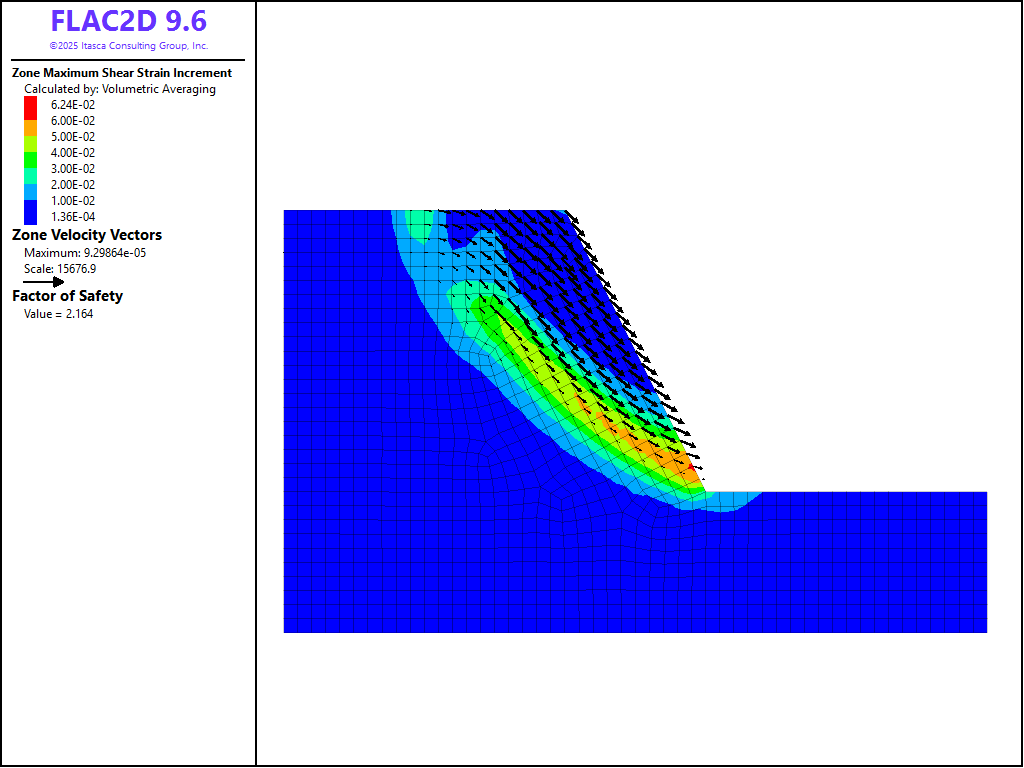
Figure 4: Factor-of-safety plot for rock slope with jointing oriented at 10° - velocity vectors and shear strain contours.
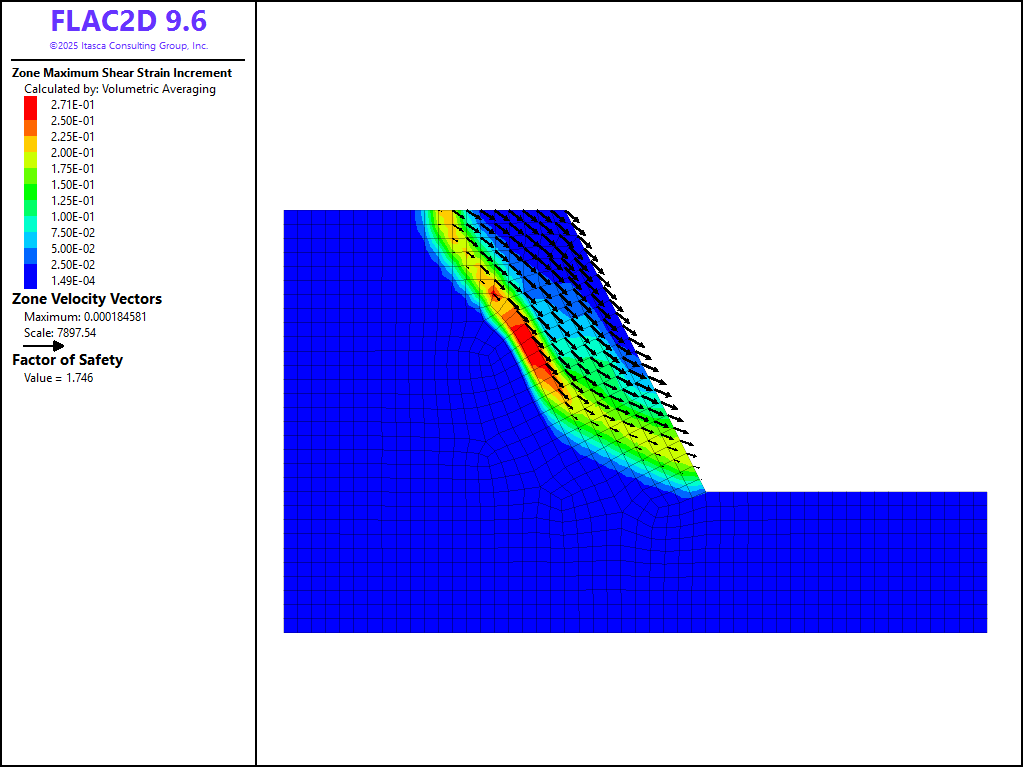
Figure 5: Factor-of-safety plot for rock slope with jointing oriented at 45° – velocity vectors and shear strain contours.
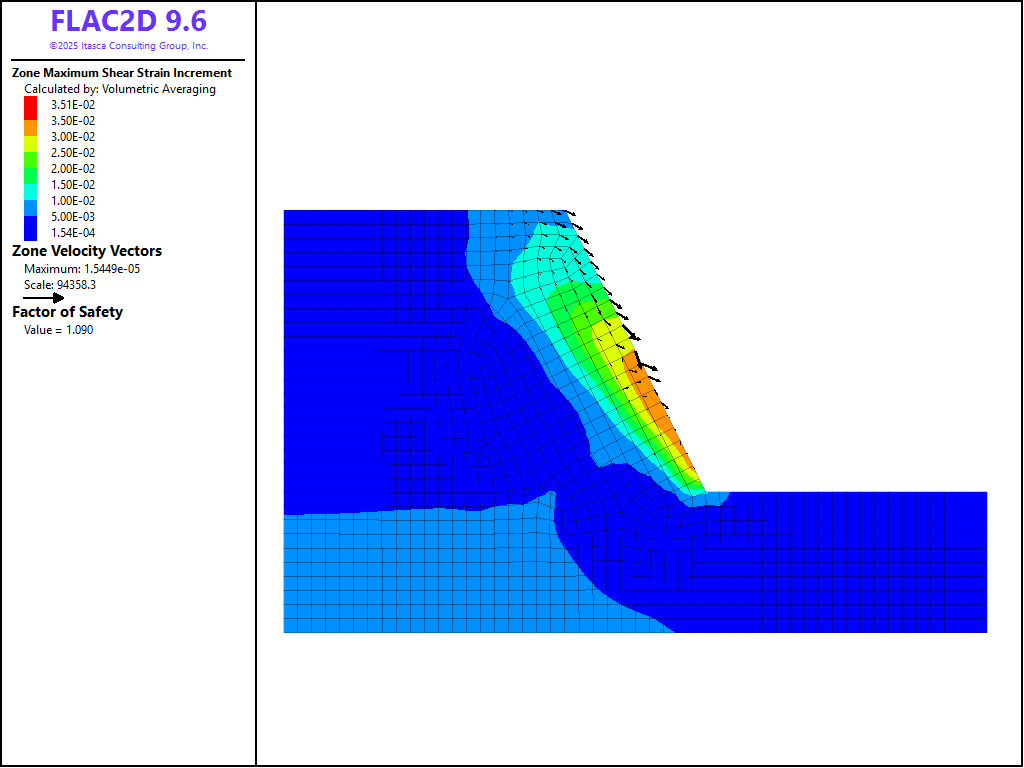
Figure 6: Factor-of-safety plot for rock slope with jointing oriented at 135° – velocity vectors and shear strain contours.
Data Files
mohr-coulomb.dat
model new
program call 'mesh.dat' suppress

model gravity 9.81
model large-strain off

zone cmodel assign mohr-coulomb

zone property density 2500.0 bulk 1E8 shear 3E7 ...
              cohesion 100000.0 friction 45.0 dilation 0.0 tension 0.0

zone face skin
zone face apply velocity-x 0 range group 'East1' or 'West'
zone face apply velocity (0,0) range group 'Bottom'
model factor-of-safety filename 'mc'
ubi10.dat
model new
program call 'mesh.dat' suppress
model gravity 9.81
model large-strain off

zone cmodel assign ubiquitous-joint

zone property density 2500.0 bulk 1E8 shear 3E7 ...
              cohesion 100000.0 friction 45.0 dilation 0.0 tension 0.0 ...
              angle=10.0 joint-cohesion=10000.0 joint-friction=40.0

zone face skin
zone face apply velocity-x 0 range group 'East1' or 'West'
zone face apply velocity (0,0) range group 'Bottom'

model factor-of-safety filename 'ubi10'
ubi45.dat
model new
program call 'mesh.dat' suppress
model gravity 9.81
model large-strain off

zone cmodel assign ubiquitous-joint

zone property density 2500.0 bulk 1E8 shear 3E7 ...
              cohesion 100000.0 friction 45.0 dilation 0.0 tension 0.0 ...
              angle=45.0 joint-cohesion=10000.0 joint-friction=40.0

zone face skin
zone face apply velocity-x 0 range group 'East1' or 'West'
zone face apply velocity (0,0) range group 'Bottom'
model factor-of-safety filename 'ubi45'
ubi135.dat
model new
program call 'mesh.dat' suppress
model gravity 9.81
model large-strain off

zone cmodel assign ubiquitous-joint

zone property density 2500.0 bulk 1E8 shear 3E7 ...
              cohesion 100000.0 friction 45.0 dilation 0.0 tension 0.0 ...
              angle=135.0 joint-cohesion=10000.0 joint-friction=40.0

zone face skin
zone face apply velocity-x 0 range group 'East1' or 'West'
zone face apply velocity (0,0) range group 'Bottom'

model factor-of-safety filename 'ubi135'
Endnote
| Was this helpful? ... | Itasca Software © 2026, Itasca | Updated: Feb 07, 2026 |
