#include <farray.h>
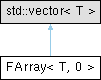
Public Member Functions | |
| constexpr | FArray () |
| Default constructor - the array size is zero. | |
| ~FArray () | |
| Destructor. | |
| constexpr const FArray< T, S, uint64 > & | operator= (const FArray< T, S, uint64 > &f) |
| bool | operator== (const FArray< T, S2, uint64 > &f) const |
| uint64 | size () const |
| size_type | stackSize () const |
| Returns the size of the array pre-allocated on the stack. | |
| size_type | allocated () const |
| bool | empty () const |
| T * | data () |
| T & | front () |
| T & | back () |
| uint64 | find (const T &t) const |
| size_type | capacity () const |
| void | push_back (const T &t) |
| Adds a new element to the end of the array, increasing the array size by one. | |
| T * | emplace_back () |
| T * | emplace_n_back (size_type n) |
| void | pop_back () |
| Removes the last element in the array. The results are undefined if the array is of zero length. | |
| void | resize (uint64 i, const T &t=T()) |
| iterator | insert (uint64 i, const T &t) |
| void | put (uint64 i, const T &t) |
| Adds a value to the array, first making certain it is big enough to hold it. | |
| void | append (const C &in) |
| Appends the contents of one FArray onto another. | |
| bool | remove (uint64 i) |
| size_type | removeAll (const T &t) |
| void | clear () |
| void | reset () |
| void | reserve (size_type s) |
| void | clip () |
| iterator | begin () |
| const_iterator | constBegin () const |
| iterator | end () |
| const_iterator | constEnd () const |
| T & | at (uint64 i) |
| T & | operator[] (uint64 i) |
| T | value (uint64 i, const T &t={}) const |
Public Attributes | |
| T * | start_ |
| std::array< T, S > | arr_ |
| char | buffer [sizeof(T) *S] |
Detailed Description
class FArray< T, 0 >
Template specialization for S=0 - indication no stack space at all should be made. MOO NOTE: THere is no reason to use this any more, as a std::vector will leave the capacity unchanged which was the primary reason to use this.
Member Function Documentation
◆ allocated()
- Returns
- the size allocated internally – this will be S (the stack length) unless the array has been made large enough to force heap access.
◆ at()
|
inline |
- Returns
- A reference to the element at the ith location in the array. Undefined if the array length is less than or equal to i. No bounds checking is performed, even in a debug compile.
◆ back()
|
inline |
- Returns
- a reference to the last element in the array. This is undefined if the array is of zero length.
◆ begin()
- Returns
- An iterator representing the first element in the array. Implemented as a pointer. STL compatible as a random-access iterator.
◆ clear()
| void FArray< T, S, uint64 >::clear | ( | ) |
Resets the array size to zero, destroying all current elements. The allocated length is not changed.
◆ clip()
|
inline |
◆ constBegin()
|
inline |
- Returns
- An iterator representing the first element in the array. Implemented as a pointer. STL compatible as a random-access iterator.
◆ constEnd()
|
inline |
- Returns
- An iterator representing one past the last element in the array. Implemented as a pointer. STL compatible as a random-access iterator.
◆ data()
|
inline |
- Returns
- a pointer to the beginning of the array data. An FARRAY guarantees that it's internal data is contiguous.
◆ emplace_back()
|
inline |
To avoid creating a temporary object, can call this to get memory location of new lcoation at end of stack and then use it to do an in-place new. new(fa.emplace_back()) Fred(arg1,arg2);
◆ emplace_n_back()
emplace_n_back: make sure n new positions are allocated and return a pointer to the first of those positions; caller should create objects at those positions.
◆ empty()
|
inline |
- Returns
- true if the array is of zero length.
◆ end()
- Returns
- An iterator representing one past the last element in the array. Implemented as a pointer. STL compatible as a random-access iterator.
◆ find()
| uint64 FArray< T, S, uint64 >::find | ( | const T & | t | ) | const |
Searches the array to find the first element matching t. Returns the index found, or limits<size_type>::max() if not found. This search is linear time.
◆ front()
|
inline |
- Returns
- a reference to the first element in the array. This is undefined if the array is of zero length.
◆ insert()
| FArray< T, S, uint64 >::iterator FArray< T, S, uint64 >::insert | ( | uint64 | i, |
| const T & | t ) |
Inserts a value into the array at position i (the new position it will occupy). If I is past the end of the array, adds to end.
◆ operator[]()
|
inline |
- Returns
- A reference to the element at the ith location in the array. Undefined if the array length is less than or equal to i. No bounds checking is performed, even in a debug compile.
◆ remove()
| bool FArray< T, S, uint64 >::remove | ( | uint64 | i | ) |
Removes a value from the array at position i If i is past the end of the array, does nothing.
◆ removeAll()
| FArray< T, S, uint64 >::size_type FArray< T, S, uint64 >::removeAll | ( | const T & | t | ) |
Removes all values from the array matching t (operator==). Returns the number of objects removed
◆ reset()
| void FArray< T, S, uint64 >::reset | ( | ) |
Resets the array size to zero, destroying all current elements. The allocated length is reset back to the stack length, and any heap memory is returned.
◆ resize()
| void FArray< T, S, uint64 >::resize | ( | uint64 | i, |
| const T & | t = T() ) |
- Parameters
-
i The new array length. t The value assigned to new array elements (if any). Changes the actual length (not the allocated length) of the array to i. May increase the allocated length, but will not decrease it.
◆ size()
|
inline |
- Returns
- the current size of the array - NOT the stack length OR the size allocated internally.
◆ value()
|
inline |
- Returns
- A copy of the value at the ith location in the array, or t if i is an invalid index.
The documentation for this class was generated from the following file:
- C:/Source/itasca-suite/common/base/src/farray.h